
How Two Sisters Are Helping Women Reclaim Adventure, One Step at a Time
In September 2015, Ginny’s world stopped.
Her partner Maggie died. And in the stillness that followed, the questions arrived. Not one at a time, but in waves. What would it mean to be alone? How would she live in the home where Maggie had just taken her last breath? How would she work? How would she breathe?
She was the CEO of a charity and after the funeral, she returned to work. She carried on. But every evening she came home to an empty house, and the weight of that emptiness was its own thing entirely. Friends were all around her — she knew that, felt that — and still life was not the same. What happens when you no longer have that special person to plan with? To laugh with? To share those end-of-the-day stories with?
And then, beneath everything else, a question that felt almost too small to say out loud given everything she was carrying:
How would she ever holiday again?
Finding Light in the Middle of Loss
Friends kept pointing her toward a company called Walking Women. Women-only walking holidays. Ginny had always loved hiking. Maybe, just maybe.
It took a few years but eventually she booked herself on to a holiday. Ginny wanted to try something new so she picked a cross country skiing trip in Norway.
On that trip, she heard that the owner of Walking Women was ill and looking for someone to take the company forward.
Her ears pricked up and an idea started to form.. She thought, “Was it time to change my life completely?”
Nothing happened immediately, as Covid arrived and travel stopped. This gave Ginny the time to reflect on a bigger question: What did she want? How did she want to live as she moved into later life?
Ginny had always loved her work and had been lucky in every job. Her work was meaningful and rewarding. She could just continue doing what she was doing.
But, she now felt she wanted to be more active. She wanted out of the London life she had been living with Maggie for 25 years. Not to mention, every day she went to work she was right next to the hospital where she and Maggie had spent two years going every two weeks for treatment.
Every day it was there and she was reminded of a horrible experience.
“I felt I had to make a change,” she says. “To swim rather than sink.”
A New Path Forward
Ginny thought about what Diane Clarke had built when she started Walking Women. She was a homeopath who understood that what many of her clients needed most was to be more active, more connected with other women, and get out in new places. All of it good for wellbeing.
Ginny knew she needed all of these things for her herself too. And she thought: if she could keep Walking Women going, she could keep that opportunity open for so many other women.
She called her sister Sara.
Sara had spent years as a Montessori teacher, and before that had managed large teams and big budgets in a hotel group. She’d stepped back to raise three children, with grandchildren now on the way. Her Montessori nursery had closed during Covid. She had some time.
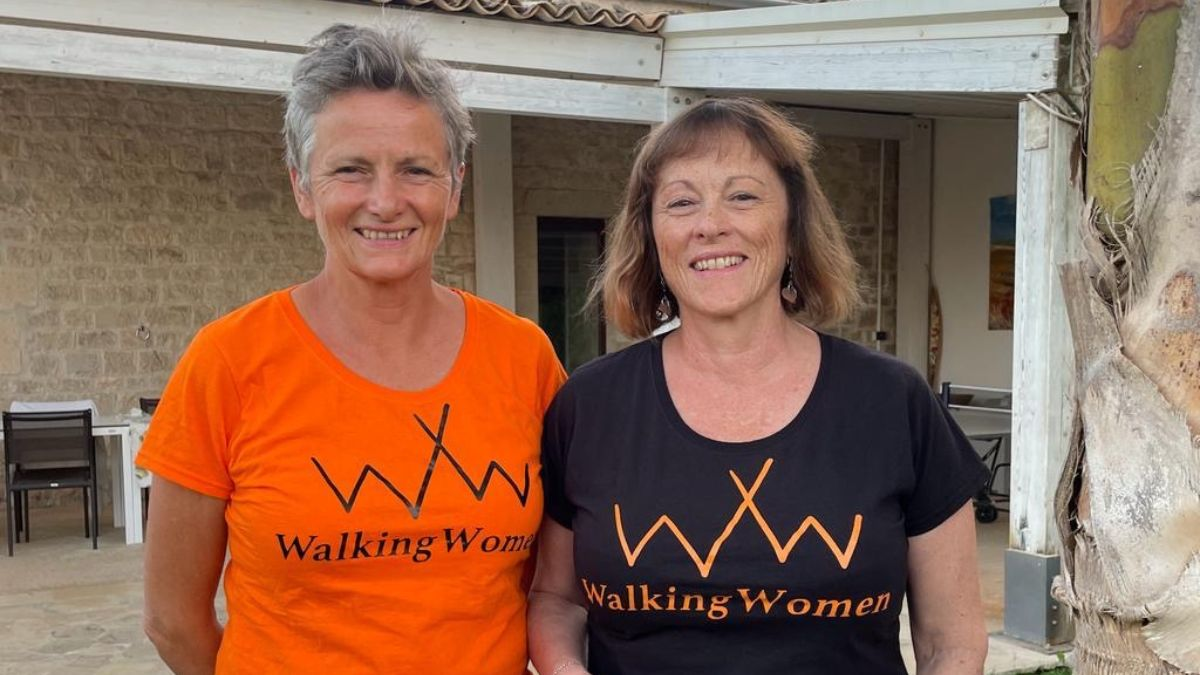
In 2021, the two sisters bought Walking Women together. Ginny was 58. What they took on was a company frozen with no activity and no assets. Their job was to revive it.
Between them, they brought a breadth of life experience that would serve them well. Sara brought hospitality, operations, the knowledge of how to run something at scale.
Ginny brought leadership, and something else — a life spent navigating a world that had not always made room for her. She had been told for years to hide who she was to get ahead. When she eventually became a CEO, one of her trustees told her: “I didn’t know lesbians could become CEOs.”
Together, she says, they had experiences that would power Walking Women on.
“Maggie was my inspiration to do this. If she hadn’t died, I never would have done it. She was a bon viveur — and that spirit lives on in Walking Women.”
What Really Happens When Women Walk Together
The biggest surprise when they reopened? The hundreds of women who came straight back. “I knew there was a loyal following,” Ginny says, “but I was surprised and extremely grateful for how many quickly came back and put their faith in us.” The guides who had worked with Walking Women for years returned too.
And trip by trip, something Ginny already knew from her own experience in Norway began to reveal itself more fully.
“It is not so much about the walking,” she says, “but about the connection between women as they walk together.”
There is a quality to conversation on a trail that is hard to replicate anywhere else. You are out in nature and active. There is space where you can walk side by side and talk or you can hang back and have your own quiet time. You are on a journey moving through something together. And at the end of the day you can share the experience.
The women who come are not one type. Some want warmth when winter has gone on too long. Some are learning a language and want to practice it somewhere real. Some have a trek on a list they’ve been carrying for years. Some want to challenge themselves, to find out what they’re capable of, to come home knowing they did something outside their usual comfort zone.
But underneath whatever specific trip they’ve booked, Ginny says, almost everyone is looking for the same thing. “What women tell us is they are looking to get away from their daily life to experience something new in the company of other women. They want to feel safe. But I think what everyone wants is to connect to others, and perhaps to make new friends — even new relationships.”
The Women Who Arrive and the Women Who Leave
“There are so many stories of transformation,” Ginny says.
On a recent trip, five of the ten women in the group were widows. “Women like me who are finding ways to holiday after losing their life partner. We also have many women who join because they won’t be judged, and who come out of themselves when they know they can just be themselves.”
Valerie arrived in Arctic Norway anxious. She was a former ultramarathoner who had been badly injured during the pandemic, and life, she says, had gone downhill in many ways. The trip had been a gift from a friend who knew her well. “I had no idea what to expect,” she wrote. “Whatever vague expectation I had, wasn’t what I found. I was intimidated and anxious.” She worried she would let people down, that she wouldn’t keep up, that she didn’t belong.
What she found instead was something she struggled to put into words. “I didn’t ever, not once, feel compared, or judged, or less than.” By the end of the trip she was writing: “I feel like at the end of summer camp when I was a kid. I have learned so much… I truly had no idea what to expect and even though I didn’t do All The Things, I’m so grateful for your acceptance.” (Read Valerie’s story here)
Shaley Howard arrived in Norway carrying a different kind of exhaustion. As a butch lesbian, she had spent years traveling the world on guard — misgendered in airport security lines, stopped outside bathroom doors, always waiting for the minor incident to become something major. “It’s a different kind of attention when you don’t fit the traditional female stereotype,” she wrote. “Always on guard — like death by a thousand paper cuts.”
On her Walking Women trip, something shifted. “What really stood out to me — more than the views, the trails, or the food — was the ease I felt just being myself. No one cared.” For someone who had spent most of her life moving through the world guarded, she wrote, “this kind of acceptance felt like a breath of fresh mountain air.” (Read Shaley’s story here)
What You Need to Know Before You Go
Walking Women runs trips across Europe and beyond — Norway, Ecuador, the Galapagos, coastal paths, mountain passes. But you don’t have to be an experienced hiker to show up.
“The main thing is to have a spirit of adventure,” Ginny says. “Any woman can be a good fit if she is curious.”
For women who want to start walking more but feel intimidated, Ginny’s advice is simple: find a local walking group first, to get yourself moving and build your confidence. And then come to one of Walking Women’s Zoom sessions about upcoming holidays — a chance to hear from the guides, from women who’ve already been, and to ask the questions that are sitting in the back of your mind.
The guides, she says, are everything. “They are well-trained and very experienced at guiding groups. They are the heart and soul of a trip.”
One thing women consistently say they didn’t expect? A celebration on their birthday. “We make a thing of birthdays,” Ginny says, “and sometimes women say they hadn’t expected that.”
The Invitation
Walking Women’s oldest walker was 94. She stopped joining the holidays at 92.
Ginny and her sister are planning expeditions built specifically for older women. Sometimes we feel we can’t do so much later in life, but adventure doesn’t have an age limit. “We are firm believers of the third act being the time you can still be curious, be out there, and be role models for other women.”
If you have been sitting on the fence, wondering if adventure is possible for you, Ginny has one thing to say to you:
“Just do it. We are here to make it easy and you are supported every step of the way.”
Recently, a woman heard Ginny on a late-night radio show talking about women staying active in later life. Her passport had expired. She renewed it. She booked a trip.
That is usually how it starts. Not with certainty. Just a small decision to go.
Women who walk together have hope together.
It started with grief, and became something else entirely — a company, a community, a reason to keep going. Maggie, the bon viveur who loved life deeply, would have understood that completely.
Your Next Adventure Starts Here
Every week I share the stories of women over 50 who are getting outside, exploring, and choosing adventure. Subscribe and they’ll land in your inbox every Sunday.
