
Why Nature Feels Like Coming Home: The Science Behind Our Deep Connection to the Outdoors
Why we feel connected to nature
This morning an Instagram reel stopped my scroll. I know I always feel connected to nature when I am out exploring the forest and today I learned why we feel connected to nature.
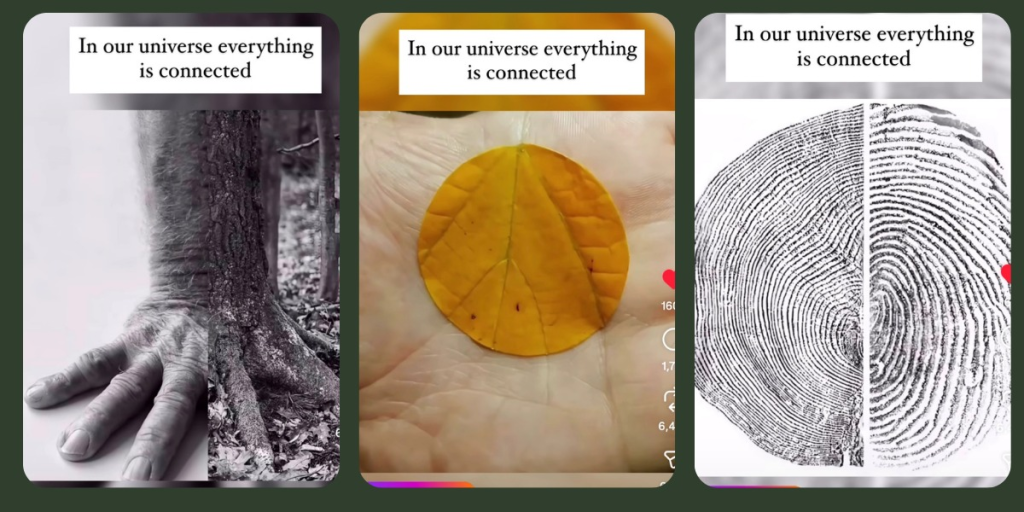
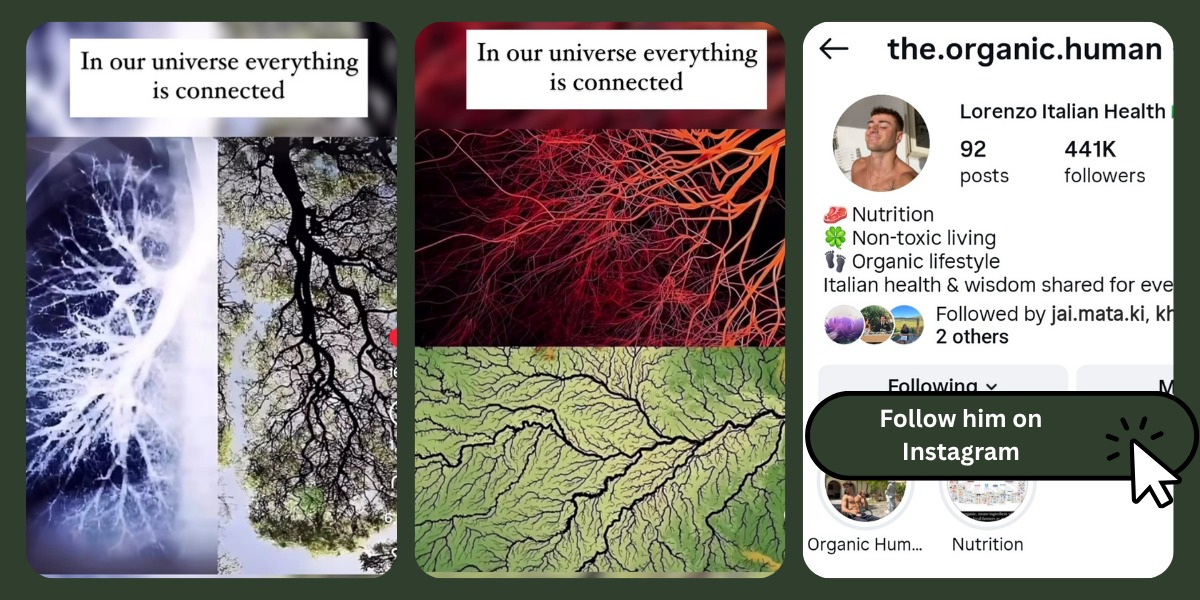
It showed these stunning side-by-side images; the branching of our lungs mirrored in the branches of a tree, blood vessels replicating the patterns of river deltas, the veins of a leaf beside the lines in a palm, tree rings matched with a fingerprint, a human forearm and hand with fingers outstretched seamlessly blending into a tree trunk with roots spreading beneath.
The caption simply said: In our universe everything is connected.
We are nature. And understanding why we feel connected to nature makes that
And understanding why we feel connected to nature makes that grounding, calming, healing feeling we get outdoors starts to make perfect sense.
(Below are some of the images from the reel and I encourage you to visit his profile here to see the complete reel.)
Here’s what I discovered, my fellow explorer, this connection is not just woo-woo, hippy dippy stuff. There is actually a whole lot of science backing up why nature has such a profound effect on us. The effect is not just “in our heads” – it’s a measurable set of physiological and psychological responses to the natural world.
1. Our Minds on “Recharge Mode”
Researchers Rachel and Stephen Kaplan figured out that our brains have two kinds of attention.
First, there’s “focus mode” (they call it Directed Attention). This is the go-getter brain we use to answer emails, solve problems, and navigate traffic. It’s powerful, but like any muscle, it gets tired. When it’s fatigued, we feel stressed, cranky, and can’t concentrate.
Second, there’s “explorer mode” (Soft Fascination). This is what happens when you’re watching leaves move, listening to a stream, or staring at the clouds. Your mind is interested but not working hard. You’re effortlessly present.
Being in nature gives your “focus muscle” a much-needed rest. It’s like putting your brain on a charger, which is why you come back from a walk feeling refreshed and able to think clearly again.
There’s also something deeper here called the Biophilia Hypothesis. Despite it’s big-word name, it just means we are “hardwired” to love nature.
Consider this: For over 95% of our evolutionary journey—that’s 288,000 of our 300,000 years as a species—we lived fully immersed in the natural world. It wasn’t a place we visited. It was home.
That’s why being in the woods or by the ocean feels so right. It’s a homecoming.
2. Why we feel connected to nature: Our Bodies Know
This isn’t just a feeling – your body is physically changing when you’re outside.
It chills out your “fight-or-flight” response.
In the city, we’re constantly on low-level alert. Nature flips that switch, moving our nervous system from its stressed-out “sympathetic” state to its calm “parasympathetic” state ( you might know it as “rest and digest”).
It literally lowers stress.
Studies show that just 20-30 minutes in a park can measurably lower your levels of the stress hormone, cortisol.
Your vitals slow down.
Your heart rate, blood pressure, and even muscle tensions all decrease. It’s your body’s way of sighing in relief.
3. A Deep Breath for Our Senses
Think about all the “noise” our brains filter every day. The hum of the fridge, the glare of screens, the background traffic. Our senses are overworked.
Nature is like a spa day for your senses.
Sight: The colors green and blue are inherently calming to the human eye. But there’s more. Our brains love the repeating, intricate patterns found in ferns, pinecones, and leaf veins. These patterns are called fractals – complex, organic shapes that our brains are perfectly evolved to process. Looking at them is a form of “visual rest’“ that feels effortless and deeply calming.
Sound: The sounds of water, wind, and birds create what researchers call “natural soundscapes.” They physically soothe the brain in a way car horns and phone notifications simply can’t.
Smell: Ever notice that rich, earthy smell in a forest? You’re breathing in compounds from the trees and soil. In Japan, they call this “forest bathing” (Shinrin-yoku), and research shows that inhaling these natural compounds can boost your immune system and lower stress.
The Science Right Outside Your Door
The science isn’t inventing anything new, it’s just catching up to what we’ve always intuitively known. That deep sense of connection we feel to nature isn’t just in our heads. It’s in our cells.
And here’s the best part; you don’t need to plan a huge backcountry expedition to get these benefits.
You can find it right outside your front door. In a city park, on a patch of grass, or just by paying attention to the single tree on your street.
This is exactly why the very first prompt for our 30-Day Walking Practice, which you can starte anytime, is a Grounding Walk. It’s the perfect way to put all this amazing science into practice. To stop just reading about it and start feeling it.
It’s a simple walk designed to help you reconnect and start your week feeling centered.
I hope you find some time to get outside today. It’s time for you to feel connected to nature.
